Tampilkan postingan dengan label Art and Culture. Tampilkan semua postingan

27 Februari, 2014

Amaq Darwilis, The last sasak Puppets Maestro

Amaq Darwilis -
Photo By Lychos Photography
AMAQ DARWILIS-The Last Sasak Puppet Maestro - His name is Amaq Darwilis, the last sasak puppets maestro.

Sasak puppet is special puppet of Sasak tribe living in Lombok. Sasak puppet looks like Bali puppet. Based on the history, Sasak puppets has existed in Lombok since 1464 M. Wayang Sasak formerly used to preach Islam in Lombok, but now Sasak puppet is commonly presented in exhibition or cultural show.

Gamelan that accompanies wayang Sasak composed of ceng-ceng, suling, tawa-tawa, kendang, pleret, and kempul. Sasak puppet show needs 10 people to help organize the show. The organizer is consisting of a puppeteer, two assistants to organize puppet puppeteer, and seven drummers of gamelan.

In Lombok Island, the famous puppeter is Lalu Nasip. He started playing puppet since he was in the 5th grade of elementary school. Our hope is that young generation will help to preserve the culture.

25 Juni, 2012

Oncer Dance

Oncer Boy - Photo by Lychos Photography
Oncer Girly - Photo by Lychos Photography
This dance is a dance together which consisted of three groups of six or eight people carrier called kenceng kenceng dancers, two men carrying a drum called the dancers drums, and one person called a dancer petuk, petuk carrier. Each group brought their own movements. Oncer can dance danced by both men and women, but the role one plays the role of men. Can be played at the arena or on the stage of the day and night.

Oncer dance are closely related with the Gamelan, Gendang ( Drum) Beleq. Beleq drum beaten while dancing with a unique movement. Gamelan Drum Beleq numerous in the island of Lombok.

This dance consists of three parts including:
- Motion Bukaq trap
- Motion Lizard Ngengos
- Motion Rebek taping
- Motion Tereng Repoq
- Motion Tindoq
- Motion Cempaka Panclang
- Motion Keroton Kombol
- Motion Sandal Kebak

After the dance ended, the dance will be closed with respect hersap sate together in the formation by placing both hands clasped in front of the face.


23 Mei, 2012

Sade : Lombok traditional Village

http://images.detik.com/content/2011/12/06/1275/img_20111206190046_4ede03ee9bab5.jpg

http://johansobihan.files.wordpress.com/2010/09/04-perempuan-sasak.jpg

Sasak is a native of the island of Lombok. As with other ethnic groups in Indonesia, Sasak tribe comes from the descendants of Austronesian that migrated from mainland Asia approximately 5,000 years BC and lived in areas in Southeast Asia to the South Pacific Islands. Currently 85% of the population is ethnic Sasak Lombok. Although Lombok Balinese culture was strongly influenced by the majority Hindus of Bali in Lombok but the majority of Sasak tribe embraced Islam.

Sasak tribe known for its belief that Telu Wektu Islamic faith that has elements of Hindu, Buddhist, and other ancient traditional beliefs. Although the Sasak tribe embraced the belief Wektu Telu but they continue to perform five obligatory prayers. There is also a small minority who hold the belief that Bodha called animism and Buddhism. These two religious groups live in harmony in a society.

The most ancient Sasak village is the village of Bayan, near the foot of Mount Rinjani which is a stronghold Wektu Telu. However, the most frequently visited by tourists is the village of Sade and Rembitan Village, near Mataram. The villagers chose to ignore the outside world modernisai and prefer to continue to preserve their old traditions.

Most of the tribes sasak worked as farmers, while women are more adept at weaving, producing beautiful Lombok ikat cloth.

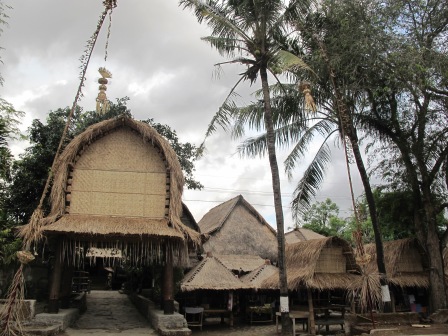
The house was built in march where Sade's most prominent and typical Lombok is a granary built on wooden piles with four hat-shaped roofs made of reed or elephant grass. Rice is inserted through the open window. Beruga or ceremonial hall stands on the six pillars and the roof is also made of elephant grass, giving a cool atmosphere when the weather is sunny and warm on a cold night. Customary house is divided into three parts, namely the kitchen, bedroom and living room.

Dance and drama in Lombok related to cultural identity. Although the Sasak culture of Bali and Java, influenced the culture in Lombok but the combination is unique and different. It is interesting to observe you.

Dance during the ceremony one of which is the extension of Belek where the most popular. Two musicians played using a large drum in the face and Batek line featuring military processions are usually held in the city Lingsar. This dance is the Dutch East Indies soldiers dressed with wooden rifles.

In the area of ​​Islam, the orchestra developed tambourines use a drum of bronze gamelan instruments, but still retain the original bronze gamelan. However gamelan instruments are still used extensively throughout the island.

In Bayan, once a year celebration of the mosque there are old-fashioned straw called Bayan Beleq.

Another event worth watching is Peresehan, the local tradition of a fight between two men used a long cane and a small square shields made of cowhide. Previously, these activities are a real war but currently only done to entertain tourists.

Every year, around February, the celebration was held with the advent of Bau Nyale marine worms along the beach Lombok is believed to bring luck and prosperity.

22 Mei, 2012

Getting Together for the Rituals of Rice


http://blog.nationmultimedia.com/home/blog_data/105/105/images/Lombok-farmers.jpg

IN THE face of pressure to adopt agricultural technology to improve the efficiency of rice production, many Lombok farmers adhere to traditional practices and rituals which exemplify the spirit of togetherness.
Often rejecting time-efficient harvesting machines and other modern equipment, the farmers rigidly maintain their system of ngerampek which draws communities together to participate in all aspects of the rice growing process.
Many Lombok communities produce two rice crops a year and others, in the high-rainfall Mount Rinjani foothills, can produce three of four crops. Often one crop is being planted while a nearby padi is ready for harvest.
Across the island, though, from planting until harvest, rice farmers manage the process in a spirit of togetherness in which traditions determine work groups and their tasks.
In the south, ngayah is a local term which defines how traditional farmers produce their rice in partnership. A ngayah group of five to 10 men will spend about half a day taking rice seedlings from one padi and tying them into bundles of a particular size for spreading in another padi that has been ploughed for planting.
“At our place there is a ngayah group and traditional wages are paid, for example, to the person who binds the rice seedlings before they are planted,” said farmer Marham, 50, from Tempos village in West Lombok’s Gerung district.
Marham is a member of his community’s Ngayah group which is named Pade Angen.
Once the bundles of rice seedlings have been distributed, at certain distances apart, the Ngayah group’s work is done. The field is ready for planting which is the task of a group of around 10 women named ngelowong.
In the planting season, the ngelowong leader will usually call the group to work both in the morning and afternoon. The women form a line in the padi and start to plant neatly. It is skilled and intensive work that will end for the day only as the sun is setting.
At harvest time, the groups of men and women will work together. The men are responsible for separating the rice grains from the stalks by a method named ngerampek in which bundles of rice stalks are banged against a traditional wooden structure to release the grains.
http://images.inmagine.com/img/iris/imagebrokerrm-044/ptg01087343.jpg
One the rice stalks are discarded, the women are tasked with gathering those grains that have not been released through ngerampek. Through this system named mepes, the women usually gather up to one-and-a-half baskets of grains.
“Although there are modern machines for harvesting, this traditional system still survives as it allows the farmers of Lombok to practice togetherness,” said farmer Badrain of Narmada in West Lombok.
The spirit of togetherness is also expressed when Lombok farmers perform rituals of thanksgiving to God for fertile soil and abundant crops.
Lombok’s indigenous Sasak people, who are Muslim, traditionally express gratitude to God for agricultural success as well as other achievements in life.
In Panarukan village in West Lombok, Sasak people offer thanks to God by performing the roah gumi ritual after a harvest, when the community will eat and pray together, and by carrying offerings to all corners of their rice fields.
Lombok’s Hindu community will conduct the traditional Ngalapin ceremony as a means of reflection and of offering thanks to the Laksmi, the goddess of prosperity, for abundant yields. The Hindus also perform the ceremony to encourage better crops in the future.
The ngalapin ceremony is led by a priest, usually at the harvest site, and is accompanied by drumming on bamboo and other traditional instruments.
Geographical proximity and historical links between Lombok and neighbouring Bali, where most people are Hindu, have over time caused the development of many cultural similarities between the people of the two islands.

Lombok Traditional House


Sasak house is a traditional ancestral house of  the ethnic group in Nusa Tenggara Barat, Indonesia. The roof of this house is made from straw and the wall is built from plaited bamboo. Sasak house has unique floor. The floor is created from clay that mix with dung (of buffalo), latex, and straw ash. The function of that mixture is like cement.
All materials to build a Sasak house are from the environment around them, even to connect parts of the wood, they don’t use iron nails, they use bamboo nails. And the house’s sole access is through a narrow door and no windows there
House isn’t just a dwelling place, but also has aesthetic values and philosophical messages inside the architecture for the dweller. The shape of Sasak house was developed when the Karang Asem monarchy existed in the 17th century. Lombok architecture is integrated with Bali architecture, for example, the living room doesn’t have walls and the top of prop is carved. Lombok and Bali are two other different islands in the Indonesian archipelago.

http://mygiza.files.wordpress.com/2011/06/house-of-sasak-tribe.jpg
Depending on the location, house on Dusun Segenter is built by using mirror principle (the door of a house is facing the door of the other house, and there is a berugak in the middle). Berugak is like a living room, but it isn’t inside the house.
(Berugak)
On Dusun Limbongan, a house is behind the other house. So, the house is not facing another house like on Dusun Segenter. Beside that, on Dusun Sade there is mixture principle of Dusun Segenter’s principle and Dusun Limbongan’s principle.
The construction of Sasak House has a connection with Islam’s perspective. In a house, there are three stairs, three stairs are the symbol of human life (birth, grow, death), and family (father,mother, and children). And the meaning of four berugak props are the symbol of Islamic Laws (Qur’an, Hadits, Ijma, and Qiyas).
The location of the parent’s house is in the highest level of the other house, followed by the oldest son, and youngest child is in the bottom level. This is a teaching of moral character, the older brother should behave and be a role model to the younger brother.


21 Mei, 2012

LOMBOK RELIGIOUS DIVERSITY

by : Lucretia Prang, posting at : http://www.lombok-network.com/travel_tales/lombok_diversity.html

Most people in western countries are under the impression that Lombok is purely islamic. With this article I would like to explain the religious diversity of this beautiful island and also educate foreigners about the fact that the islamic population here is very moderate. In recent times, Indonesia had to cope with acts such as the Bali bomb and the Marriot hotel incident, which caused a negative effect for the economy and tourism.  

Looking at the pure islamic values, these incidents are against the Muslim religion and people in Lombok do not agree with them.

Here people are open to every culture, religion and nationality.

Foreigners who have visited this piece of paradise know very well what I am expressing.

Not only can we experience the religion of Islam here, we also have the chance to learn about Balinese Hinduism and Buddhism.

As an anthropologist I have been always very interested in the different cultures here and in past times of my Lombok research I made the pleasant discovery that different religions live rather harmonious on this small island.

The Balinese have been here since the 17th century, especially in West Lombok. Various traces of the Karangasem Raja times can be viewed all over Cakranegara and Narmada, not to forget Batu Bolong Temple near Senggigi. Taman Narmada, a majestic water palace built by one of the Balinese rajas in the 19th century, is a wonderful historical example – you also can go swimming here.

Suranadi, a bit further, has another beautiful temple and a swimming pool built by Dutch colonials. Here you can refresh your body and soul in Awet Muda – the name for water that keeps you young and beautiful – try!

The Buddhist community is seldom recognized but quite important for Lombok history. A Swiss anthropologist, Albert Leemann, found out in the early 1900’s that the actual ethnic population of Lombok originates from Burma, today Myanmar, and therefore brought Buddhism to this region.

However, some time ago I took some Australian anthropology students to a very isolated Buddhist community near Pemenang, West Lombok. We had to walk about 2 hours through bamboo forests, rivers and up a steep mountain pass.

Once there we reached the local Vihara, the actual Buddhist temple. In front of the temple, a huge Banyan tree and a view to kill for: the three gilis at its best.

The village is very simple, plain bamboo huts and everybody chewing betel-nut and being very relaxed.

As to Lombok Islam, it is in fact a very colorful religion, in some parts of the islands intermingled with elements of traditional aspects and traces of Hinduism. Lombok Islam is very unique and tolerant.
 
Hopefully visitors will take their positive impressions back home and will tell other people so that negative reports in the media will be wiped out and people can look for themselves by visiting this truly interesting and magic place, Lombok.

Lombok Traditional Clothes

http://www.kriyalea.com/wp-content/uploads/2012/04/tenun-sasak-6.jpg
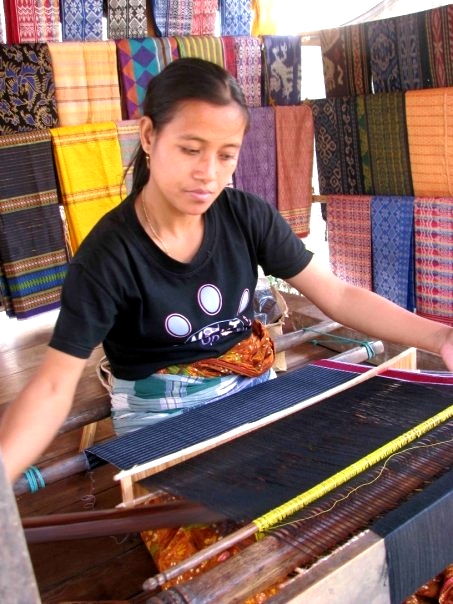
Woven fabric or cloth known as songket is the hallmark of the island of Lombok. Songket cloth is a woven fabric made by adding weft technique, decoration was made by inserting a silver thread, gold thread or yarn lungsi color above, sometimes there is also decorated with beads, shells or coins. Now this center is the village craftsmen Sukarara songket, here if you want to buy the traditional woven cloth Lombok, and see how the weavers do their jobs.
Its location is 25 miles by road from the city of Mataram. The village is very interesting to visit because of the daily activities of people in this village had been weaving. The hallmark of the village Sukarara woven is woven using gold thread, this village has been known to be one of the most visited attractions by domestic and foreign guests. In this village along the road are many shops that sell fabric woven from local villages as well as from the surrounding villages.
http://i.pbase.com/v3/12/372012/1/44342852.7.jpg

The women in traditional Sasak village with clothes are always ready to demonstrate their skills. But other than songket cloth is known today was a lot of the women who weave these activities are still carried the traditional way, the classic way aka ancient times, in addition to keeping the traditions as well as a tourist attraction.
http://suhartono-the-art.blogspot.com/2011/10/outdoor-portrait-model-in-sasak.html
Manufacture of woven fabrics of classical or traditional ways of preparing these is the manufacture of yarn and dye manufacture. Making yarn traditionally by using weights that diputar2 with jari2 hand, the weight shaped like a top made of wood or terracotta.
Materials to make yarn other than cotton, bark, banana fiber, pineapple fiber, palm leaves etc.. Making color substance consisting of two colors blue and red. The blue color obtained from indigo or Mirinda Citrifonela or noni. In addition there are other dyes from plants like kesumba (sono rivet), which would really deeehh jaduull … but fun!
Regarding this macam2 songket motifs, there is a chicken motif, there is another motive trus eight flowers, four flower motifs and is still very much anymore motif2 other, let alone getting into the rural part of the more motif2 with masing2 sense, meaning each motif has a meaning and sendiri2 meaning. Na if temen2 now prefers lizard motif (see also Kain songket Sasak) because the people of Lombok believe these animals can bring good luck

Presean (Stick Fighting)

http://famoustourisms.com/wp-content/uploads/2011/03/presean-lombok1-600x879.jpg


Presean is a Cultural Symbol Masculinity Youth Sasak tribe on the island of Lombok. The event was a battle of two menarmed with rattan sticks Sasak or so-called copyists and armored skin thick and hard buffalo commonly called the ende. ordinary fighter and the referee called pepadu called pakembar Few edge and the center referee called pekembar. Presean ceremony begins only from the surge of emotion before the kingdom era soldiers after defeat an opponent on the battlefield.
Presean is already known by the community for a long time, until finally in preserved until now become entertainment Month celebration is held every August. Presean is very unique when in mix martial arts styles in the modeling bythe pepadu. Just use the pants / gloves without clothes and a cane in his right hand and a shield made of animal skinsin his left hand, two young men who are in front of hundreds penonoton manhood pitted each other. While dancingaccompanied by gamelan music (music lombok) second pepadu dispel mutual opponent with penyalen without anxiety or fear.
Uniquely Presean the participants have never put up, the audience can participate and take over to become a fighter
.. The rules also do not make the fighters confused, just can not hit the bottom of the stomach. If pepadu (Fighter) got head to leak means deemed KO the game should not be on continue again if pepadu (fighter) bleeding, although pepadu would not give up ..
Gifts that are not fighting about how kalao in comparison with the wound .. But many young men who took over in thismatch .. Presean is also often in lombakan between villages, districts, even to the national … Presean also been held in the Dept YEAR 2004/2005. also even at & JOGJA even SEMARANG and much more. Presean does not carry grudges among the pepadu in because the pepadu required to shake hands and hug in friendship, there is no sign of resentment and all just a game.

Sorong Serah Aji Krame ( Lombok Traditional Marriage Ceremony )

Customary marriage in community of Lombok traditional ceremonies associated with the transfer slide charm spell. A young man (terune) can obtain a wife under customary in two ways: first by soloh (woo the girl's family); both ways merariq (run girl), Having already done one way, then the man's family will do the layout marriage according to customary ways Sasak.

Lombok marriage ceremony is often associated with traditional wedding ceremony is sliding the hand over aji hospitality which is one tradition that existed since ancient times and has been attached with the strong and the whole order of life in East Lombok Sasak people, even some good people among the religious leaders and figures indigenous peoples themselves stated that if it does not perform these ceremonies would be a disgrace for the family and the local community.

Slide the hand-over comes from the word that means pushing and sliding the hand over, which means hand, so sliding the hand over a statement of consent of both parties from both the women nor the men in the procession of a marriage between terune (youth) and dedare (girl).


Sliding the hand over ceremony is one of the most important series of ceremonies at wedding processions in traditional Sasak of Lombok. The marriage procession in full is as follows:

1. Mesejati
Implies that of the men sent some people to local community leaders or traditional leaders to report to the head or keliang village / hamlet to announce the marriage of the identity of the prospective groom and the subsequent report to the family of women.

2. Selabar

Containing the intent to treat proclaim to the family of the bride who followed up with talks covering aji hospitality customs of the values ​​on the basis of valuation 33-66-100 kepeng perforated or kepeng jamaq, sometimes even selabar this event coupled with guardian requests at once.

3. Taking Wali
What is meant by taking the mayor is taking the guardian of the woman can be directly at selabar or a few days after the execution selabar and this depends on the agreement the two sides (kapisuka)

4. Taking Appointments
In the implementation takes this promise is talking about sliding the hand over and aji hospitality in accordance with the customs prevailing in the village or villages of origin prospective bride.

5. Sorong Serah
The core of the implementation of sliding the hand over ceremony was the official announcement of the marriage of a man and a woman who is accompanied by the bride equipment delivery boy or known by the name-ajen ajen.

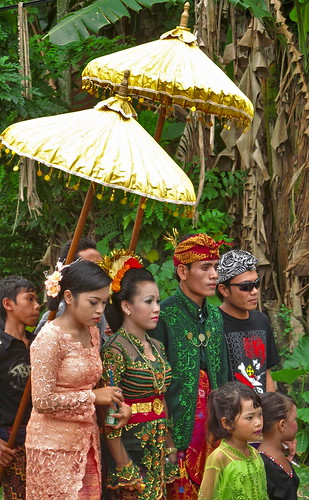
6. Nyongkolan
In the implementation of the family Nyongkolan men accompanied by the bride and groom to visit the families of women accompanied by relatives and friends by using the traditional dress accompanied by gamelan even Beleq drum.

7. Balik Lampak
Is one tradition to visit the homes of parents in particular women with both parents the male. 

source : http://sebiebeaq.blogspot.com/2011/07/sorong-serah-aji-krame-lombok.html

Gandrung Dance

Gandrung is a traditional dance from Indonesia. Gandrung has many variations and is popular in Bali, Lombok and East Java, among the Balinese, Sasak and Javanese (especially Osing Javanese). The most popular variation is Gandrung from Banyuwangi region in the eastern peninsula of Java, so much that the city is often referred as Kota Gandrung or the City of Gandrung.

Originally a ritual dance dedicated to the goddess of rice and fertility, Dewi Sri, it is currently performed as a social dance of courtship and love in communal and social events, or as tourist attraction.

Descriptions

Gandrung is named from Javanese word for love. It is theorized that the dance originated in ritual dance to express love of the people to the rice goddess, Dewi Sri, with trance and as a kind of fertility dance. However, it is currently lost its ritual connotations, especially among Muslims Javanese and Sasak. The dance evolved into social dance describing a girl looking for love companions. The dance therefore has been de-ritualized, and mostly lost its connection with the rice divinity.

Gandrung usually performed in an all-night performance that begins sometime around 9 p.m. and ends just before dawn.  Gandrung is also commonly played as tourist attraction,[1] for example in Bali or in Grajagan Bay in Banyuwangi. It is also performed as social dance in communal and social events such as circumcision or wedding.

The "gandrung", or the main dancer, is usually an unmarried girl or a transvestite (or simply boys playing the role of female dancers). The dancer dressed in traditional costume, with fan, shawl and wearing ornamental headgear. Often there are more than one gandrung dancer in the performance.

Gandrung usually started with the dancer(s) in side of stage surrounded by gamelan ensemble. When the music started, the dancer would start the dancing movement with hip thrusting and move to the center stage. When the gandrung spots an audience member she wishes to dance with, she throws her shawl to the audience to bring him to the stage.[5] The dancer and the audience member will then dance together. If there is more than one gandrung dancer in the performance, each dancer will choose a partner and dance with their respective partners. The audience member who had danced with the gandrung usually gives a small amount of money as token of appreciation. Gandrung is now also performed as dance of courtship and love, between girls and boys in central and eastern Lombok. It is usually performed outdoors by the young men and women of the village with everyone standing around in a circle.

Similar dances are known throughout the Indonesian archipelago, such as ronggeng or tayuban in East and Central Java, jaipongan in West Java and Banten, and joged in Jakarta.


Music

The dance is performed to the tunes of a traditional ensemble similar with gamelan, often composed of two violins, gendangs, bonang and gongs with gamelan xylophones (gambang). A singer is also present to sing the accompanying song for gandrung performance. Villages in Banyuwangi, Bali and Lombok sometimes has their own gandrung music ensemble. Variance in ensemble composition existed between difference area where gandrung is performed The music has been described as "vibrant and earthy"  and has been recorded by several anthropologists.

Gendang Beleq


Gendang beleq is a dance and music performance from Lombok island, Indonesia. It is a popular performance among the native Sasak people.
The name gendang beleq is a Sasak language term, which means "big drum (big gendang)",as the performance is about a group of musicians playing, dancing and marching with their traditional instruments, centered around two big drum (gendang) players.

Instruments

The ensemble for gendang beleq performance consists of main players with of two (occasionally four) large drums. They are followed by players using a gong, a traditional flute (suling), some hand-held kettle-gongs (similar with bonang), and many sets of cymbals.The size of the ensemble is usually 12-15 persons, with 3 person to carry and play the heavy gong.
The drum is made from a wood frame with goat skin drum-head. The wood is selected from woods which is hard yet light. The goat skin is selected from goats that are approximately 5 years old to make drums with the best sound. There are two different types of gendang used in the ensemble: the male and female gendang. Each is made from a male and female goat. These two types of gendang have different sound quality.
The player for the ensemble is called sekehe. It is composed of men only (usually young boys).There are many gendang beleq clubs in Lombok. These clubs are supported and sponsored by the Indonesian government as a way to promote Sasak culture and to involved youth the cultural activities.The clubs usually practice once a week.During performances, the players will use colorful traditional Sasak dress, which are similar to the related Balinese dress.

History
Gendang beleq performance during colonial era. ca. 1934.
Gendang Beleq is a variant of gamelan oncer, a gamelan form in Lombok. It is used for ritual purposes and as a performance to encourage Sasak warriors that were going into, or returning from, the battlefield. It is part also of the ceremony in Pura Lingsar, one of the main Hindu temples in Lombok.
The popularity of Gendang Beleg has increased since the 1990s due to support and promotion by the Indonesian government to promote local art performances. Presently the performance is not only in a ritual context but also in cultural festivals or for tourist performances.

Performances

In a Gendang beleq performance, the drummers carry and play gendang and dance a dramatic and confrontational duet. The drummers play interlocking tune with their large drums.Aside from able to play their instruments, the players must have the agility and stamina to perform the dance and marching with their instrument.
Gendang beleq can be performed during life-cycle ceremonies, such as celebration of birth, circumcision, wedding and funeral. It can also be performed in a ceremony to invoke rainfall or in a celebrations for national holidays.
In Sasak wedding, gendang beleq performance is part of the nyongkolan ceremony, where the family of the groom went in a parade to the bride's house to bring her to the location of the marriage ceremony.
The West Nusa Tenggara provincial government held "The Master of Gendang Beleq" competition where gendang beleq players compete to decide the best team. It is held in front of Governor office in Mataram, Lombok
Outside Lombok, the performance is popular among migrant Sasak in other islands of Indonesia, such as in the neighbouring Sumbawa Island.